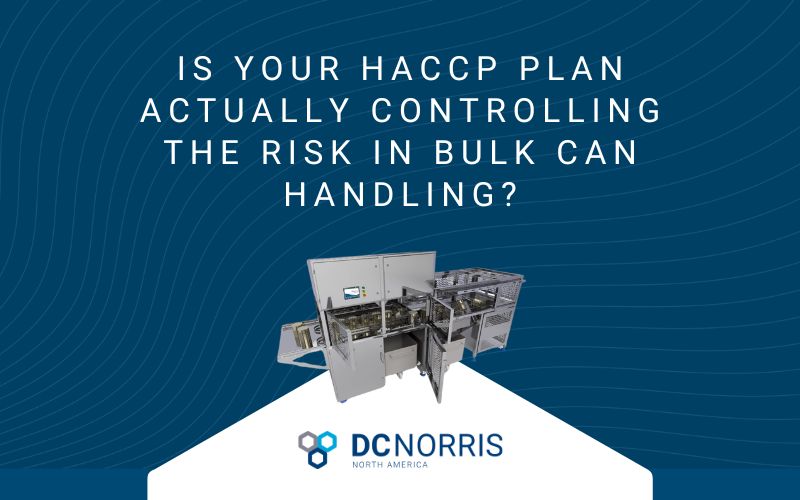
DC Norris North America’s AutoCan 1000 gives high-volume kitchens and food manufacturers a controlled, documentable process where manual handling used to be the only option.
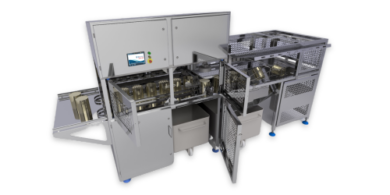
Most institutional foodservice operations have a HACCP plan. Fewer have a clear answer to what that plan actually says about bulk can handling, who opens the cans, how they’re rinsed, what happens to lid fragments, and how any of that is documented across shifts.
That gap is more common than it might seem. In high-volume production environments processing hundreds or thousands of A10 cans per shift, can handling is typically a manual, operator-dependent process. Rinse technique varies. Speed varies. Attention to lid fragments varies. None of that variability is captured in most documentation, and none of it is visible in an audit.
The risk isn’t hypothetical. It’s the kind that doesn’t surface until something goes wrong.
Why Bulk Can Handling Is a Blind Spot in Most Food Safety Plans
Institutional foodservice operations have made enormous strides in formalizing food safety processes. Temperature monitoring, allergen protocols, and cold chain compliance are well-documented, regularly audited, and tightly controlled.
Bulk can handling rarely receives the same scrutiny. And yet, for a facility processing hundreds or thousands of cans per shift, it represents a significant point of variability. Every operator develops their own rhythm. Rinse technique varies. Speed varies. Attention to detail varies. None of that variability is captured in your documentation, and none of it is visible in an audit.
This is precisely the kind of process gap that regulatory environments are moving to close. HACCP frameworks are increasingly expected to account for the full ingredient handling chain, not just cooking temperatures and holding times, but the upstream steps where contamination risk enters the equation.
A Controlled Process Replaces a Variable One
DC Norris North America introduced the AutoCan 1000 to the U.S. and Canadian markets specifically to address this gap. As the exclusive North American provider of the system, we’ve worked with high-volume food manufacturers and institutional operations to understand where manual can handling breaks down and how best to resolve those challenges.
The AutoCan 1000 is a single-operator system that automates five steps in one continuous sequence: pre-rinse, open, empty, rinse, and crush. What previously required multiple operators and produced inconsistent results now runs through a controlled, repeatable process housed in a single piece of equipment.
“The AutoCan 1000 addresses the common bottlenecks in can processing. It simplifies high-volume production by integrating multiple functions into a single machine, allowing one operator to manage the process efficiently and safely while reducing labor, utility, and floorspace demands.” – Dick Smith, President, DC Norris North America
 “The AutoCan 1000 addresses the common bottlenecks in can processing. It simplifies high-volume production by integrating multiple functions into a single machine, allowing one operator to manage the process efficiently and safely while reducing labor, utility, and floorspace demands.” – Dick Smith, President, DC Norris North America
At up to 1,000 A10 cans per hour, the throughput numbers are significant. But for foodservice directors, the more operationally relevant details lie in the safety architecture.
The Safety Architecture That Makes The AutoCan 1000 Audit-Ready
The AutoCan 1000 is built for environments where food and operator safety accountability are non-negotiable. Key design elements include:
- Blow-off nozzles and pre-rinse systems that reduce contamination risk before the can is opened
- Interlocked guarding and safety switches that enforce process integrity at each stage
- HMI touchscreen operation that standardizes the process across operators and shifts, creating a consistent, documentable workflow
- All 316 stainless steel construction for durability and sanitation compliance
- Pneumatic cylinders for precise, repeatable positioning and opening
The HMI touchscreen, while seemingly simple, deserves more attention. In environments where HACCP compliance and audit readiness are ongoing priorities, operator-dependent processes are inherently difficult to defend. Standardized, monitored, and logged operation closes that gap. It gives you documentation of what actually happened at the can handling step, not just what your SOP says should happen.
The Sustainability Case Can’t Be Ignored
For institutional operators navigating procurement mandates and internal ESG commitments, can waste management is increasingly part of the conversation and is increasingly scrutinized.
Standard disposal practices, unrinsed, bulky cans going into waste bins, create two compounding problems. First, material recovery facilities (MRFs) routinely reject or downgrade cans contaminated with food residue, which undermines recycling compliance and drives up waste costs. Second, the sheer volume of empty cans in an active kitchen creates logistical friction that adds up over every shift.
The AutoCan 1000’s rinse-and-crush sequence reduces empty can volume by up to 80 percent and produces clean, compact material that MRFs are able to accept and process. For operations working toward sustainability targets, that’s a meaningful and measurable contribution.
The Upstream Automation Shift Worth Paying Attention To
Automation in institutional kitchens has moved steadily upstream in recent years. The focus has shifted from cooking and portioning toward the earlier, equally high-risk stages of ingredient handling. This isn’t a trend driven by technology for its own sake. It’s driven by a food safety environment that keeps raising its expectations and by operators who recognize that manual, variable processes at any stage in the production chain are liabilities.
Standardizing bulk can handling is no longer just an efficiency argument. It’s a risk management argument. As audit standards continue to evolve, the operations that can document a controlled, consistent process at every step will be better positioned than those that can’t.
Common Questions About the AutoCan 1000
What can sizes does the AutoCan 1000 handle?
Can one operator run the AutoCan 1000?
How does the AutoCan 1000 support HACCP compliance?
Will it integrate with our existing production line?
Where is the AutoCan 1000 available?
Ready to See How It Fits into Your Operation?
If you’re managing a high-volume institutional kitchen or production facility and want to understand whether the AutoCan 1000 is a fit, our team can walk you through the system, answer application-specific questions, and arrange a full demonstration.