When people hear “supercharge your kettle,” it’s easy to assume we’re talking about a new kettle system. Sometimes we are, but not always. As DC Norris North America President Dick Smith put it in a recent conversation, “It’s the ability to take a standard kettle, any kettle, not just one of ours, and meaningfully improve its efficiency with a handful of targeted additions.”
That distinction matters. The kettle on your floor is already installed and already part of how your line runs. Sometimes improving it can be a faster path to more output than replacing it.
Three additions do most of that work:
- Jet Cook™ steam injection
- In-vessel homogenizers and emulsifiers
- Recipe Manager
Each one targets a different part of the batch: how fast it heats, how it’s mixed, and how consistently it’s run.
Jet Cook™ Supercharges Kettles New and Old
Supercharging a kettle means getting more performance out of the same vessel and the same footprint. For most processors, Jet Cook™ is where that starts.
In a traditional steam-jacketed kettle, heat has to pass through the vessel wall before it reaches the food. That’s slow, and it scorches product onto the wall. Jet Cook™ heats from the inside instead. Its patented nozzle injects steam directly into the product, where it then collapses and releases heat right where it’s needed.
The difference shows up fast. A standard kettle typically takes roughly 25 minutes to bring water to a boil. With Jet Cook™, it takes 6 to 8 minutes. Faster heat-up is only part of it. Eliminating burn-on shortens cleaning time, and heating product directly can consolidate production steps and improve finished product quality.
“New and old” is meant literally. Jet Cook™ can be retrofitted to almost any kettle with a minimum capacity of 80 gallons, or integrated into a new DC Norris kettle system.
How Jet Cook™ Works
The patented Jet Cook™ lance and nozzle use the Coandă principle. Because of the nozzle’s curved shape, product is drawn through it like a jet stream and is pumped, heated, and mixed at the same time. The nozzle has no moving parts, so particulate ingredients like vegetables and meat keep their integrity and cook evenly.
In-Vessel Homogenizers & Emulsifiers
Heating faster is one gain. Keeping the product in one kettle is another entirely.
On a complex product like soup, we can bring high-shear mixing into the same vessel. Ingredients reach temperature faster, and they no longer have to be transferred to and from a separate vessel for mixing. That means fewer steps, less labor, and one vessel to clean.
Dick Smith explained the benefit directly: “It’s one piece of equipment to clean. The product never leaves the vessel, so you avoid the product loss that comes with pumping it out and back.” The result is a more homogeneous mix with less handling and less cleanup.
Recipe Manager Keeps Every Batch Consistent
Faster heating and fewer transfers only pay off if every batch comes out the same. The last addition isn’t about heat at all.
Recipe Manager, DC Norris’s recipe management system, guides operators through a logical sequence of steps and records parameters like weight and ingredient additions along the way, down to confirming the final yield. It’s been part of DC Norris North America’s offering for over a decade, and it’s built around one outcome: the same result, batch after batch, regardless of who’s running the kettle that day.
Three Ways to Cook, One Vessel
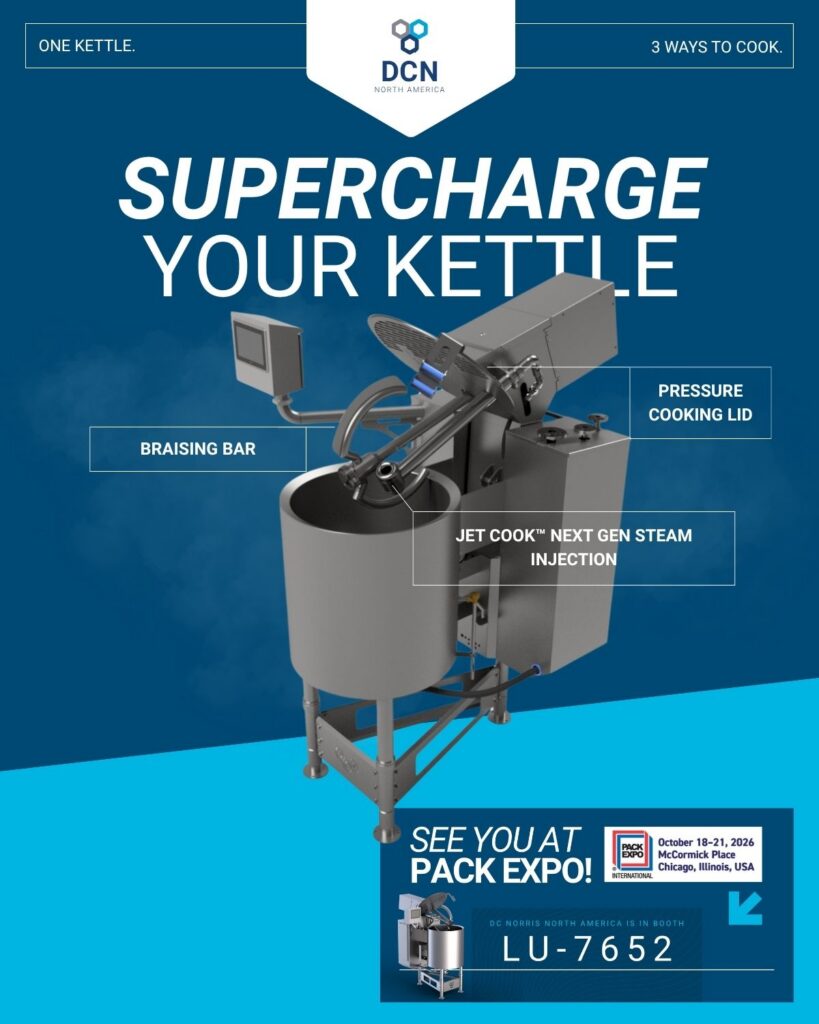
Everything above can be added to a kettle you already run. When a new kettle is on the table, a DC Norris North America kettle system goes a step further: one vessel that can braise (braising bar), cook and mix (Jet Cook™), and pressure cook (pressure cooking lid).
That flexibility lets processors run a wider range of recipes without adding a separate vessel for each cooking method, or the floor space that comes with it. It’s the same thinking behind supercharging, applied from day one: more capability from a single vessel and footprint.
One Goal, New Kettle or Old
Whether you’re upgrading the kettle you have or specifying a new one, the goal is the same: maximum performance from the vessel and footprint you’ve got. That means reduced cook times, eliminated burn-on, lower energy use, and maximized product and operator safety.
We’ll have a scale model kettle system at PACK EXPO International, Booth LU-7652, October 18–21 at McCormick Place. Stop by, or book a meeting ahead of the show. We look forward to it!