Summary of this post: 
When a customer asks whether they need a CT-1 or a larger sous vide cook tank, the real question isn’t about the size. It’s about process. The most useful conversation we can have before quoting equipment is understanding what happens in the kitchen: how the product is prepped and cooked, how it’s served, and what the cooling, packaging, and storage/transport steps are in between.
Start with the process, not the equipment
The clearest dividing line between commercial and industrial cook tank applications isn’t batch size. It’s what happens after the cook. Commercial kitchens generally cook to serve: the product goes from tank to plate within the same operation. Industrial operations cook to sell: the product is packaged and shipped to someone else who reheats it later. That distinction shapes everything downstream, from batch size and utility infrastructure to how the kitchen itself is laid out.
The commercial entry point: CT-1
The CT-1 is the one piece of equipment DC Norris North America manufactures directly, rather than sourcing through the broader DC Norris Group. In fact, the CT-1 is the only fully automated, commercial-scale sous vide cook tank made in the USA. It’s NSF-certified, sized for roughly 100 to 120 pounds per cook, and built to run without a dedicated steam utility, which makes it a practical fit for kitchens that don’t already have industrial power infrastructure in place.
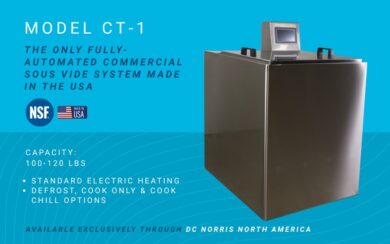
The CT-1 has three operating modes: defrost, cook, and chill. The defrost function is easy to overlook, and in practice, most CT-1 owners default to cook only and rely on a separate fridge or blast chiller rather than using the cook-and-chill capability, even though the unit is built to handle both. Knowing all three functions exist changes how a kitchen can plan its prep schedule, not just its cook schedule.
The other advantage of the CT-1 is how it scales. A kitchen can buy one, prove it out, and add another as volume grows, rather than committing to a larger capital outlay upfront. That incremental path is a real advantage for operations that are still finding their footing.
The industrial range: CT-5 through CT-20
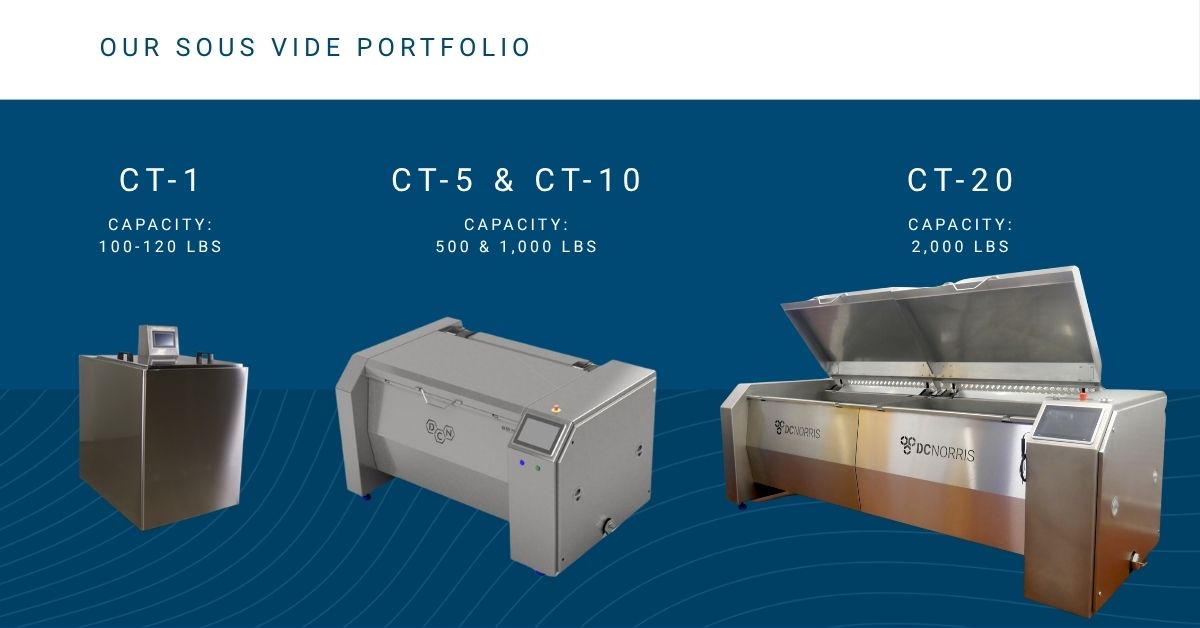
For higher-volume operations, DC Norris North America is the exclusive US and Canadian distributor for DC Norris Group’s industrial sous vide cook tank line: the CT-5, CT-10, CT-20, and CT-20V. These are industrial-grade units built for the batch sizes and duty cycles that come with cooking to sell rather than cooking to serve. A CT-5, for example, typically handles 500 pounds per cook, depending on configuration.
None of the tanks in the industrial lineup have a minimum batch size. You can run a partial load in any of them. But the real advantage of industrial-scale cooking, both the efficiency gain and the extended shelf life the process delivers, comes from cooking at volume. A partial batch works; it just doesn’t capture the full benefit of the equipment.
On geometry, the CT-5, CT-10, and CT-20 share the same horizontal footprint at increasing scale. The CT-20V is a vertical configuration: a smaller footprint but a taller unit, which makes ceiling height checks and loading/unloading equipment part of the discussion early in the planning process.
Where the math gets interesting: five CT-1s or one CT-5?
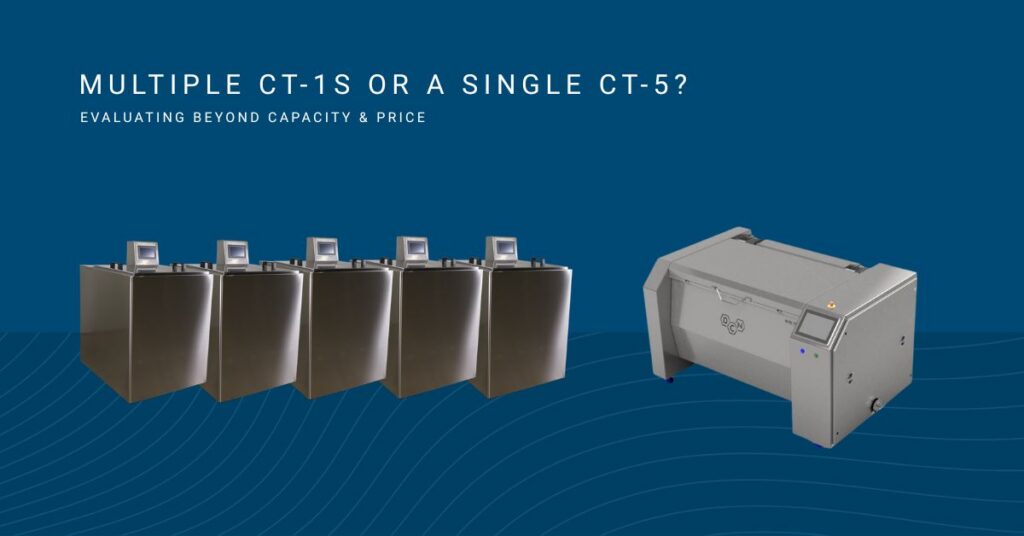 This is the question we get most often from growing operations, and there isn’t a single right answer. Cost-wise, five CT-1s and one CT-5 tend to land in roughly the same range. From there, the decision comes down to a handful of practical factors.
Flexibility is one. Several CT-1s running at once can each hold a different product at a different temperature, which a single CT-5 dedicated to one large batch can’t do. If a kitchen is cooking five different products rather than one large run of the same thing, multiple CT-1s may make more sense.
Space is the other, and it’s the one that surprises people. Each CT-1 can be placed separately from the other if space is an issue. Alternatively, a single CT-5 or CT-10 would require a larger footprint and staging area for material handling. Utilities are another factor and there’s a real crossover point where consolidating to fewer, larger tanks becomes the more space-efficient choice, even if the up-front capital commitment is bigger. The logistics of managing product between five smaller units versus a single, larger cook tank factor in as well. Again, it all comes down to process and having this set from the beginning will dictate the equipment.
There’s no formula that spits out the right answer here. It depends on the kitchen’s layout, its utilities, and what’s actually on the menu.
What a recent site visit made clear
During a recent visit to a large, multi-story facility, with the casino kitchen positioned at the center of the building, two things came up that don’t usually make it into a spec sheet.
The first was the defrost function. The operator hadn’t considered defrosting as a standalone use case, and once it was on the table, it changed how they thought about prep: defrost overnight, cook and chill the next day, and stay ahead of service without extra equipment.
The second was the glycol chiller. Conventional wisdom is to put it outside, but a roof wasn’t an option in a multi-story building with no exterior access near the kitchen. The chiller runs quietly and generates minimal heat, which meant it could go somewhere unconventional, in this case an interior changing room, without causing problems. That flexibility mattered more than any single number on the spec sheet.
Cleaning came up too, and the answer was simpler than expected: run a hot water cycle in the tank, add a standard off-the-shelf degreaser, wash and rinse, and the unit is clean in about an hour. No dedicated recipe or special procedure required.
The takeaway
Process will define the right cook tank, or the right combination of cook tanks. The process factors in the menu, how it’s served, and what mechanical and spatial constraints the kitchen already has. That’s a conversation worth having before anyone talks about equipment.
 We don’t just sell equipment; we engineer outcomes.

If you’re weighing a CT-1 against an industrial-scale tank, or trying to figure out where the crossover point is for your own operation, we’re glad to walk through the specifics with you.
Booking that first call is simple: choose a time that works for you using our meeting scheduler: